Standard of care in engineering Canada
Quick Answer
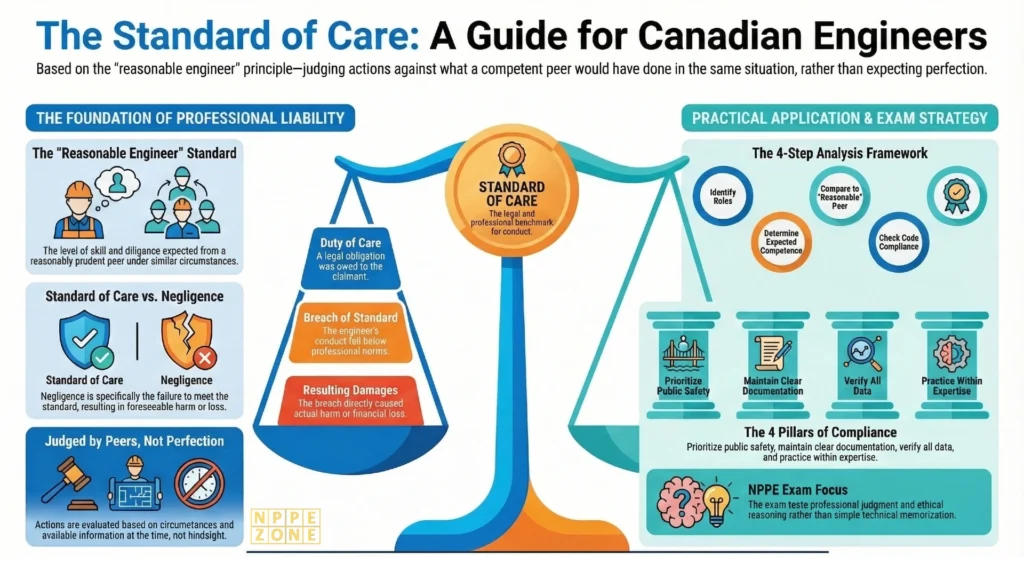
The standard of care in engineering Canada refers to the level of skill, competence, and diligence that a reasonably prudent engineer is expected to demonstrate under similar circumstances. It is a legal and professional benchmark used to assess whether an engineer acted appropriately in a given situation. In Canada, this standard is central to both regulatory discipline and negligence claims.
Introduction
The standard of care in engineering Canada is a foundational concept that defines how engineers are expected to perform their professional duties in real-world situations. It applies to design, analysis, decision-making, and supervision of engineering work.
This standard is not about achieving perfection. Instead, it focuses on whether an engineer acted in a way that a reasonably competent and experienced engineer would have acted under similar circumstances. It is a key principle used in both professional regulation and legal evaluations within Canada.The standard of care in engineering Canada is also closely tied to professional accountability, ethics, and regulatory expectations set by provincial engineering regulators. It is commonly evaluated alongside concepts such as duty of care, foreseeability, and reasonable conduct in engineering practice, making it a core element in both legal analysis and professional decision-making.
Definition of Standard of Care for Engineers in Canada
The definition of standard of care for engineers in Canada is based on the “reasonable and prudent engineer” standard.
In practice, this means:
- Engineers must apply appropriate knowledge, judgment, and diligence
- Decisions must align with accepted engineering practices at the time
- Actions are judged based on circumstances, not hindsight
This standard evolves over time as engineering practices, technologies, and professional expectations develop within Canada.
Engineering Standard of Care Legal Meaning Canada
The engineering standard of care legal meaning Canada is used primarily in tort law to evaluate professional liability.
It helps determine:
- Whether an engineer owed a duty of care
- Whether that duty was breached
- Whether damages resulted from that breach
Courts assess whether the engineer’s actions are aligned with what a reasonably competent peer would have done in similar circumstances, rather than judging against ideal or perfect performance.
In legal contexts, the engineering standard of care legal meaning Canada is often assessed using expert testimony and comparison to industry norms, professional guidelines, and established engineering practices. Courts consider whether a reasonable engineer, with similar qualifications and in a similar situation, would have acted differently, making this standard inherently comparative and context-dependent.
How Standard of Care Applies to Engineers in Canada
The how standard of care applies to engineers in Canada depends on several contextual factors:
- Complexity of the project
- Information available at the time
- Applicable codes, regulations, and standards
- The engineer’s area of specialization and experience
Engineers are expected to:
- Follow relevant professional codes and guidelines
- Exercise independent professional judgment
- Identify limitations, risks, and uncertainties
- Avoid relying blindly on others when professional responsibility is required
In practice, how standard of care applies to engineers in Canada is influenced by factors such as risk level, project complexity, public safety impact, and the availability of information at the time of decision-making. Engineers are expected to exercise professional judgment, apply due diligence, and recognize when further review, consultation, or verification is required to meet the expected standard of care in engineering practice.
Professional Standard of Care for Engineers in Canada
The professional standard of care for engineers in Canada is reinforced by regulatory bodies and professional practice guidelines.
Key expectations include:
- Competence: Practicing only within one’s area of expertise
- Due diligence: Verifying calculations, data, and assumptions
- Documentation: Maintaining clear records of decisions and rationale
- Public safety: Prioritizing the health, safety, and welfare of the public
Failure to meet these expectations may result in disciplinary action or legal consequences within Canada.
Standard of Care Engineering Law Canada Explained
The standard of care engineering law Canada explained involves applying legal reasoning to professional engineering practice.
In legal disputes:
- Expert witnesses help define what constitutes reasonable engineering practice
- Industry standards, codes, and publications may be referenced
- Courts evaluate whether the engineer’s conduct fell below expected professional norms
This assessment is contextual and based on accepted practices within the engineering profession in Canada.
Examples of Standard of Care in Engineering Canada
Examples of standard of care in engineering Canada include:
- Designing structures with appropriate safety factors in accordance with codes
- Performing adequate site investigations before finalizing designs
- Verifying calculations and reviewing drawings before approval
- Identifying and communicating risks clearly in reports
- Recommending additional analysis when information is incomplete
These examples of standard of care in engineering Canada demonstrate how professional judgment, adherence to codes, and proper verification processes collectively contribute to meeting the expected engineering standard of care in real-world scenarios.
Breach of Standard of Care Engineering Canada Cases
Breach of standard of care engineering Canada cases occur when an engineer’s actions fall below the expected professional standard.
Common breaches include:
- Design errors due to insufficient review or analysis
- Failure to follow applicable codes or regulations
- Inadequate supervision of junior engineers or technical staff
- Misinterpretation of data leading to unsafe outcomes
A breach is established when conduct deviates from what a reasonably competent engineer would have done in the same situation.
Standard of Care vs Negligence Engineering Canada
The standard of care vs negligence engineering Canada distinction is critical:
- Standard of care: The benchmark for expected professional behavior
- Negligence: Failure to meet that benchmark, resulting in harm or loss
To establish negligence, three elements are generally required:
- Duty of care existed
- The standard of care was breached
- The breach caused damages
Understanding standard of care vs negligence engineering Canada is essential because it highlights that negligence is not simply a mistake, but a failure to meet the accepted professional standard of care that results in foreseeable harm.
Thus, the standard of care is the measure used to evaluate whether negligence has occurred.
Canadian Engineering Standard of Care Guidelines and Responsibilities
The Canadian engineering standard of care guidelines and responsibilities are outlined through professional regulations, codes of ethics, and industry practices across Canada.
Core responsibilities include:
- Acting in the public interest
- Maintaining professional competence through continuous learning
- Practicing within licensed authority
- Upholding ethical and professional conduct
- Ensuring proper supervision and quality control of engineering work
These guidelines help define what is considered reasonable and acceptable professional behavior.
What the Exam Is Testing
On the NPPE, questions related to the standard of care in engineering Canada assess:
- Understanding of legal and ethical responsibilities
- Ability to distinguish between negligence and professional standards
- Application of “reasonable engineer” reasoning in scenarios
- Recognition of practical implications in engineering decisions
For the NPPE, understanding the standard of care in engineering Canada also involves recognizing how scenarios test your ability to apply ethical reasoning, interpret professional obligations, and evaluate whether an engineer’s actions align with accepted standards rather than focusing solely on technical correctness.
The focus is on judgment and application rather than memorization.
Step-by-Step Strategy for Applying Standard of Care
When analyzing a scenario:
- Identify the engineer’s role and responsibilities
- Determine the expected level of competence for that role
- Compare actions to what a reasonable engineer would do
- Consider applicable codes, standards, and regulations
- Evaluate whether risks were properly managed and communicated
- Conclude whether the conduct meets professional expectations
This structured approach supports consistent and defensible reasoning.
Practical Insights for Mastery
Understanding the standard of care in engineering Canada improves decision-making in both exams and professional practice.
Key takeaways:
- It is context-dependent, not absolute
- It evolves with industry practices
- It is judged by peers, not perfection
- Documentation and communication are essential
- Public safety is always the top priority
Practicing scenario-based questions is one of the most effective ways to internalize how this concept is applied.
Applying Standard of Care in Practice
Mastering the standard of care in engineering Canada enhances both exam performance and real-world engineering judgment. When you understand the professional standard of care for engineers in Canada, you develop a clearer framework for evaluating your own work and the work of others.
Applying the “how standard of care” applies to engineers in Canada in daily practice helps you:
- Make more informed design and analysis decisions
- Identify gaps or uncertainties before finalizing work
- Strengthen technical reports with clear justification and reasoning
- Reduce the likelihood of situations that could lead to a breach of standard of care engineering Canada cases
- Align your work with Canadian engineering standard of care guidelines and responsibilities
It also reinforces your ability to distinguish standard of care vs negligence engineering Canada, which is essential when assessing risk and accountability in professional environments.By consistently applying the engineering standard of care legal meaning Canada, engineers build stronger professional judgment, improve communication with teams and stakeholders, and ensure their work meets accepted expectations within Canada.
FAQ
1. What is the standard of care in engineering in Canada?
It is the level of skill and diligence expected from a reasonably competent engineer under similar circumstances.
2. Is the standard of care the same for all engineers?
No. It varies depending on specialization, experience, and project complexity.
3. How is standard of care determined in legal cases?
Courts rely on expert testimony, industry standards, and professional guidelines.
4. What happens if an engineer breaches the standard of care?
They may face legal liability, regulatory discipline, or both.
5. How does standard of care relate to negligence?
Negligence occurs when an engineer fails to meet the standard of care and causes harm.
6. Why is the standard of care important for the NPPE?
It tests your ability to apply professional judgment, ethics, and legal reasoning in engineering scenarios.
Final Thoughts
The standard of care in engineering Canada is a core principle that guides professional responsibility, legal accountability, and ethical decision-making. It defines how engineers are expected to act in practice and provides a benchmark for evaluating performance in both real-world situations and NPPE exam scenarios. Understanding and applying this concept consistently is essential for developing strong professional judgment and maintaining public safety within Canada.