Duty to Report: NPPE Scenarios Explained for Canadian Engineers
Quick Answer
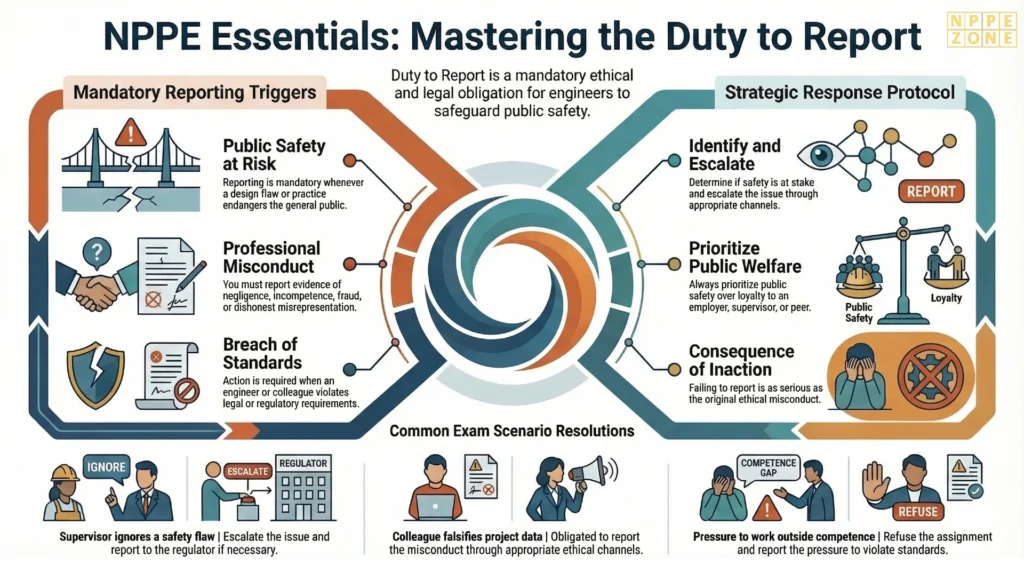
The duty to report in NPPE scenarios refers to an engineer’s ethical and legal obligation to report unsafe practices, professional misconduct, or violations of engineering standards. Understanding the duty to report NPPE scenarios for engineers in Canada is essential for passing the exam, as many questions test your ability to recognize when reporting is required and how to act appropriately.
Understanding “Duty to Report: NPPE Scenarios Explained” in Context
When candidates search for “Duty to Report: NPPE Scenarios Explained,” they are typically looking to understand how ethical obligations translate into real exam questions. In the NPPE, duty to report is not just a concept—it reflects broader NPPE ethics reporting obligations and the engineer’s responsibility under the engineering code of ethics in Canada.
This includes recognizing when reporting is required, how to act appropriately, and understanding the consequences of inaction.
What Is the Duty to Report in the NPPE?
The NPPE professional responsibility duty to report explained centres on protecting public safety, upholding ethical standards, and maintaining trust in the engineering profession.
In Canada, engineers are expected to:
- Report unsafe or unethical practices
- Disclose professional misconduct
- Act when public safety is at risk
- Follow regulatory and legal obligations
The engineering duty to report obligations Canada NPPE are not optional—they are a core part of professional responsibility and are frequently tested on the exam.These responsibilities are also aligned with NPPE reporting requirements for engineers in Canada, which emphasize accountability, transparency, and the protection of public welfare in all professional decisions.
When Must Engineers Report Misconduct in NPPE Canada?
A common exam focus is understanding when must engineers report misconduct NPPE Canada.
You are typically required to report when:
- Public safety is at risk
- There is evidence of negligence or incompetence
- Ethical violations occur (fraud, dishonesty, misrepresentation)
- Another engineer breaches professional standards
- Legal or regulatory requirements are violated
Failing to act in these situations can lead to serious professional consequences.
NPPE Duty to Report Scenarios for Engineers in Canada
Understanding NPPE duty to report scenarios for engineers in Canada is critical because the exam uses real-world situations.
Example Scenario 1: Safety Risk Ignored
You discover a design flaw that could endanger the public, but your supervisor tells you to ignore it.
Correct approach:
You must escalate the issue and report it if necessary. Public safety always comes first.
Example Scenario 2: Colleague Misconduct
A colleague falsifies data to meet project requirements.
Correct approach:
You are obligated to report this misconduct through appropriate channels.
Example Scenario 3: Employer Pressure
Your employer asks you to approve work outside your area of competence.
Correct approach:
Refuse and report if necessary. Practicing outside competence violates ethical standards.These types of NPPE duty to report ethical scenarios explained are common and require clear judgment.
NPPE Duty to Report Examples and Case Studies
Reviewing NPPE duty to report examples and case studies helps reinforce how these situations apply in practice.
Common case themes include:
- Ignoring safety warnings
- Signing off on incomplete or inaccurate work
- Failing to disclose conflicts of interest
- Overlooking unethical behavior
These scenarios reflect real life duty to report cases engineering Canada, making them highly relevant for exam preparation.
What the NPPE Is Testing in Duty to Report Scenarios
When it comes to NPPE exam questions on duty to report scenarios, the exam is not testing memorization—it is testing judgment. Specifically, it evaluates your ability to:
- Recognize ethical risks and reporting triggers
- Apply NPPE professional responsibility duty to report explained principles
- Prioritize public safety over employer or peer pressure
- Understand engineering duty to report obligations Canada NPPE in real situations
This is why practicing NPPE duty to report ethical scenarios explained is essential—you are being tested on how you think, not just what you know.
How to Answer Duty to Report NPPE Questions
Knowing how to answer the duty to report NPPE questions can significantly improve your score.
Use this approach:
1. Identify the Risk
Is public safety, ethics, or legal compliance at stake?
2. Determine Responsibility
Are you directly responsible, or do you need to escalate?
3. Apply Ethical Principles
Follow codes of ethics and professional standards.
4. Choose the Best Action
Reporting is often the correct answer when safety or ethics are compromised.
NPPE Exam Questions on Duty to Report Scenarios
NPPE exam questions on duty to report scenarios are typically:
- Scenario-based
- Focused on ethical decision-making
- Designed to test judgment, not memorization
You may be asked:
- What should the engineer do next?
- Whether reporting is required
- Which ethical principle applies
Understanding patterns in these questions is key to success.
Consequences of Failing to Report NPPE Ethics Scenarios
The consequences of failing to report NPPE ethics scenarios can be serious both on the exam and in real life.
Potential consequences include:
- Risk to public safety
- Professional discipline or loss of license
- Legal liability
- Damage to reputation
The NPPE emphasizes that failing to report can be just as serious as the original misconduct.
Why Duty to Report Is Critical for NPPE Success
Understanding NPPE professional responsibility duty to report explained is essential because:
- It is a high-frequency exam topic
- It reflects real-world engineering responsibilities
- It tests your ethical reasoning and judgment
- It aligns with Canadian engineering regulations
Mastering this topic improves both exam performance and professional readiness.
Mastering Duty to Report NPPE Scenarios for Exam Success
Mastering duty to report NPPE scenarios for engineers in Canada is one of the most effective ways to improve your exam performance and confidence.
By consistently practicing NPPE duty to report examples and case studies, you begin to recognize patterns in how ethical dilemmas are presented. This allows you to quickly identify when reporting is required, even in complex situations.
One of the most valuable skills you can develop is understanding how to answer duty to report NPPE questions under pressure. Instead of second-guessing, you learn to rely on core principles such as public safety, honesty, and professional accountability.
Focusing on real life duty to report cases engineering Canada also helps bridge the gap between theory and practice. This ensures that you’re not only prepared for the exam, but also ready to handle ethical challenges in your engineering career.Ultimately, by strengthening your understanding of engineering duty to report obligations Canada NPPE and applying structured reasoning, you can approach the exam with clarity, confidence, and a strong ethical foundation.
Why Mastering Duty to Report NPPE Scenarios Gives You a Competitive Advantage
Developing a strong understanding of duty to report NPPE scenarios for engineers in Canada does more than help you pass the exam—it builds the foundation for ethical decision-making throughout your engineering career.
By consistently practicing NPPE duty to report examples and case studies, you train yourself to quickly recognize when action is required, even in complex or ambiguous situations.
One of the biggest benefits of mastering NPPE duty to report ethical scenarios explained is improved confidence during the exam. Instead of second-guessing your answers, you’ll clearly understand when must engineers report misconduct NPPE Canada and how to respond appropriately based on professional standards.
Focusing on NPPE exam questions on duty to report scenarios also strengthens your ability to apply knowledge under pressure.
Another key advantage is understanding the real-world impact of your decisions. Studying real life duty to report cases engineering Canada helps reinforce accountability and public safety.Finally, by fully understanding engineering duty to report obligations Canada NPPE and the consequences of failing to report NPPE ethics scenarios, you position yourself not only to succeed on the exam but to act with integrity in your future role.
FAQ: Duty to Report NPPE Scenarios
What is the duty to report in the NPPE?
It is the obligation of engineers to report unsafe practices, misconduct, or ethical violations.
When must engineers report misconduct in Canada?
When public safety is at risk, or when ethical or legal violations occur.
Are duty to report scenarios common on the NPPE?
Yes, they are a major part of the exam and frequently tested.
How do I answer the duty to report questions correctly?
Focus on public safety, ethical responsibility, and professional standards.What happens if you fail to report misconduct?
It can result in disciplinary action, legal consequences, and harm to public safety.
Final Thoughts
Understanding the duty to report NPPE scenarios for engineers in Canada is essential for both passing the exam and practicing responsibly as a professional engineer.
By studying NPPE duty to report examples and case studies, learning how to apply ethical principles, and practicing scenario-based questions, you can confidently approach this topic on the exam.
This reflects the core idea behind “Duty to Report: NPPE Scenarios Explained”—applying ethical judgment in real-world engineering situations. The key is simple: when in doubt, prioritize public safety, act ethically, and follow professional obligations. Mastering this mindset will not only help you pass the NPPE—but also prepare you for real-world engineering responsibility.