NPPE Code of Ethics Explained
Quick Answer
The NPPE code of ethics for engineers in Canada outlines the professional and moral responsibilities engineers must follow to protect public safety, act with integrity, and maintain professional accountability. It is a core component of the NPPE exam and focuses on how engineers should behave in real-world scenarios, particularly when balancing technical decisions with ethical obligations.
Introduction
Understanding the NPPE code of ethics is essential for anyone preparing for the NPPE exam in Canada. The exam evaluates not only technical knowledge but also an engineer’s ability to apply ethical reasoning in professional situations. This guide provides a clear breakdown of the engineering code of ethics NPPE exam breakdown, helping you understand the key principles, responsibilities, and practical applications required to succeed.
NPPE Code of Ethics for Engineers in Canada Explained
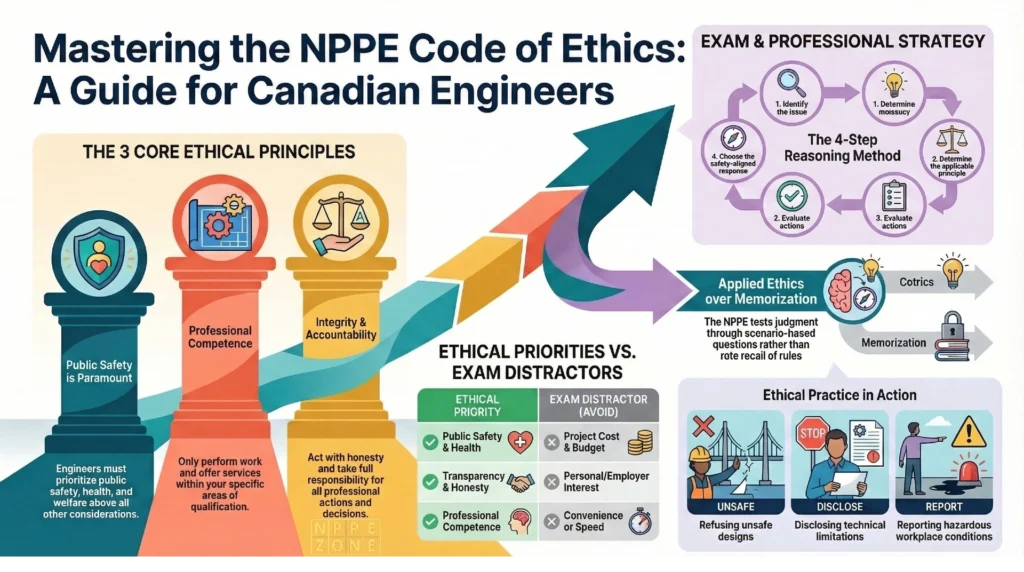
The NPPE code of ethics for engineers in Canada explained centres around the idea that engineers must act in the public interest while maintaining honesty, integrity, and competence. Engineers are expected to:
- Prioritize public safety, health, and welfare
- Perform work only within their areas of competence
- Act with honesty and transparency
- Avoid conflicts of interest
- Maintain confidentiality where appropriate
These principles form the foundation of professional engineering conduct across Canada.
Engineering Code of Ethics NPPE Exam Breakdown
The engineering code of ethics NPPE exam breakdown typically focuses on applied understanding rather than memorization.
Candidates are expected to:
- Interpret ethical dilemmas in scenario-based questions
- Identify violations of professional conduct
- Apply ethical principles to real-world situations
- Understand the consequences of ethical breaches
The exam tests how well you can reason through situations using ethical frameworks.
Key Principles of NPPE Code of Ethics Explained
The key principles of NPPE code of ethics explained include:
- Public safety: Engineers must protect the public above all else
- Competence: Work must be performed within one’s qualifications
- Integrity: Engineers must be honest and transparent in their work
- Objectivity: Decisions should be unbiased and based on facts
- Accountability: Engineers are responsible for their professional actions
These principles guide ethical decision-making in both the exam and professional practice.
Common Ethical Challenges in NPPE Scenarios
Understanding the NPPE code of ethics explained also involves recognizing common ethical challenges that appear in exam scenarios. These situations often test how well a candidate can apply the NPPE code of ethics for engineers in Canada explained in practical contexts.
Typical challenges include conflicts of interest, pressure from employers or clients, incomplete or uncertain data, and situations where safety may be compromised for cost or time efficiency. In these cases, the NPPE ethics guidelines and professional responsibilities explained require engineers to prioritize public safety and maintain professional integrity.By practicing with examples of NPPE code of ethics in practice, candidates can better understand how to respond to these challenges and improve their ability to apply the key principles of NPPE code of ethics explained under realistic conditions.
NPPE Ethics Guidelines and Professional Responsibilities Explained
The NPPE ethics guidelines and professional responsibilities explained include expectations set by Canadian engineering regulators. Engineers must:
- Follow applicable laws, codes, and standards
- Disclose conflicts of interest
- Maintain professional competence through ongoing learning
- Supervise work appropriately when responsible for others
- Ensure accuracy and clarity in reports and communications
These responsibilities ensure engineers maintain trust and credibility in society.
Examples of NPPE Code of Ethics in Practice
Examples of NPPE code of ethics in practice include:
- Refusing to approve a design that does not meet safety standards
- Disclosing limitations in a technical report
- Avoiding involvement in work outside one’s expertise
- Reporting unsafe conditions or practices
- Properly supervising junior engineers or technical staff
These examples demonstrate how ethical principles are applied in real-world engineering decisions.
NPPE Code of Ethics Summary for Canadian Engineers
The NPPE code of ethics summary for Canadian engineers can be simplified into a few core ideas:
- Protect the public
- Act with integrity and honesty
- Work within your competence
- Be accountable for your actions
- Follow professional and legal standards
This summary helps candidates quickly recall the main ethical expectations when studying or answering exam questions.
How to Apply NPPE Code of Ethics in Exam Scenarios
Knowing how to apply the NPPE code of ethics in exam scenarios is critical for success. A practical approach:
- Identify the ethical issue in the scenario
- Determine which principle applies (e.g., safety, competence, integrity)
- Evaluate the actions of the engineer involved
- Choose the response that aligns with public safety and professional responsibility
- Avoid answers that prioritize convenience, cost, or personal interest over ethics
This structured reasoning helps you select the correct answer consistently.This approach is especially important when learning how to understand NPPE code of ethics for exam preparation, as it reinforces the ability to interpret scenarios consistently and align responses with professional and ethical expectations.
NPPE Professional Code of Ethics Rules and Explanations
The NPPE professional code of ethics rules and explanations are based on professional engineering standards in Canada.
Key rules include:
- Engineers must hold public safety paramount
- Engineers must only practice within their competence
- Engineers must avoid misleading statements
- Engineers must maintain confidentiality when required
- Engineers must act as trustworthy professionals
These rules are enforced by provincial and territorial regulatory bodies.
Simple Explanation of NPPE Code of Ethics for Engineers
A simple explanation of NPPE code of ethics for engineers is:
Engineers must do their work honestly, competently, and responsibly while always putting public safety first. If an engineer faces a situation where decisions could affect people, the ethical choice must prioritize safety, transparency, and professional integrity.This aligns with the NPPE code of ethics summary for Canadian engineers, making it easier to recall and apply during exam scenarios.
Step-by-Step Strategy for Understanding NPPE Ethics
To effectively understand and apply the NPPE code of ethics:
- Learn the core ethical principles
- Study common scenarios and case examples
- Practice identifying ethical violations
- Focus on public safety as the top priority
- Use elimination techniques in multiple-choice questions
- Review mistakes to improve reasoning
Consistency and practice are key to mastering ethical application.
Using this method also improves your ability to apply the NPPE code of ethics in exam scenarios, ensuring that your answers reflect both logical reasoning and adherence to professional standards.
Practical Insights for Exam Success
Mastering the NPPE code of ethics is less about memorization and more about understanding how to think like a professional engineer. Candidates who perform well typically:
- Apply principles logically rather than guessing
- Recognize patterns in ethical dilemmas
- Prioritize safety and responsibility in every scenario
- Understand the intent behind ethical rules
Developing this mindset improves both exam performance and professional judgment, especially when interpreting the engineering code of ethics NPPE exam breakdown, where questions evaluate reasoning rather than recall.
Why NPPE Ethics Matters in Practice
Understanding the NPPE code of ethics for engineers in Canada explained is not only important for passing the exam but also for long-term professional success. Strong ethical judgment helps engineers make better decisions, communicate more effectively, and maintain trust with clients, employers, and the public.
By applying the key principles of NPPE code of ethics explained in real-world situations, engineers can reduce risk, avoid professional misconduct, and ensure their work meets regulatory expectations.Learning how to interpret NPPE ethics guidelines and professional responsibilities explained also strengthens your ability to handle complex scenarios where technical and ethical considerations overlap. This is especially useful when applying NPPE code of ethics in exam scenarios, where the correct answer often reflects prioritizing safety, integrity, and accountability over convenience or cost.
Applying NPPE Ethics in Real-World Engineering Practice
Mastering the NPPE code of ethics for engineers in Canada explained goes beyond exam preparation, it directly improves how engineers perform in professional environments. By understanding the NPPE professional code of ethics rules and explanations, engineers can confidently navigate workplace challenges while maintaining compliance with Canadian engineering standards.
Applying the key principles of NPPE code of ethics explained in daily practice helps engineers make more informed decisions, especially when faced with uncertainty, time pressure, or conflicting priorities.
Understanding NPPE ethics guidelines and professional responsibilities explained allows engineers to better evaluate situations such as design approvals, safety concerns, and reporting obligations.
Using the NPPE code of ethics in exam scenarios during preparation reinforces your ability to quickly identify violations and choose answers aligned with professional standards.Ultimately, having a strong grasp of examples of NPPE code of ethics in practice and the NPPE code of ethics summary for Canadian engineers gives you a practical framework that supports both exam success and long-term career development.
FAQ
What is the NPPE code of ethics?
It is a set of professional principles that guide engineers in Canada to act responsibly, ethically, and in the public interest.
What are the main principles of the NPPE ethics?
Public safety, competence, integrity, objectivity, and accountability.
How is ethics tested in the NPPE exam?
Through scenario-based questions that assess your ability to apply ethical reasoning to real-world situations.
Do I need to memorize the NPPE code of ethics?
No. Understanding how to apply the principles is more important than memorization.
Why is the NPPE code of ethics important?
It ensures engineers act responsibly and protect the public while maintaining professional standards.
Final Thoughts
The NPPE code of ethics is a fundamental component of both the NPPE exam and professional engineering practice in Canada. Understanding its principles, responsibilities, and real-world applications will not only help you succeed on the exam but also prepare you for ethical decision-making throughout your engineering career.