NPPE Exam Passing Score Canada: What You Need to Know to Pass with Confidence
Preparing for the NPPE (National Professional Practice Examination) can be stressful, especially when you’re wondering, “What is the NPPE exam passing score in Canada?” I’ve mentored dozens of engineers — both students and working professionals — through this exam, and I can tell you that understanding the minimum passing score for the NPPE exam Canada is more about strategy than memorization, and implementing NPPE exam success strategies for Canadian engineers can significantly increase your confidence and results. In this guide, I’ll break down the passing thresholds, how many questions you need to pass the NPPE exam in Canada, grading methodology, and practical tips to help you meet the NPPE passing grade requirements for engineers in Canada confidently on your first attempt.
What is the NPPE and Why the Passing Score Matters
The NPPE isn’t a technical exam. You won’t see thermodynamics, circuits, or structural equations on it. Instead, it tests engineering law, ethics, professional responsibility, public safety, and regulatory compliance. Think of it as a way to ensure that once you’re licensed, you understand how to act responsibly as a professional engineer in Canada.
Knowing what percentage is required to pass the NPPE exam Canada helps you plan your study approach. Too many students aim for perfection and burn out; others aim too low and risk leaving questions unanswered. Understanding the NPPE exam scoring system for Canadian engineers allows you to focus strategically on high-impact areas.
Personal anecdote: One of the EITs I mentored was terrified of failing. Once I explained how the NPPE exam is graded in Canada and that consistent understanding mattered more than memorization, their stress dropped. They passed on their first try — confidence made all the difference.
How the NPPE Passing Score is Determined in Canada
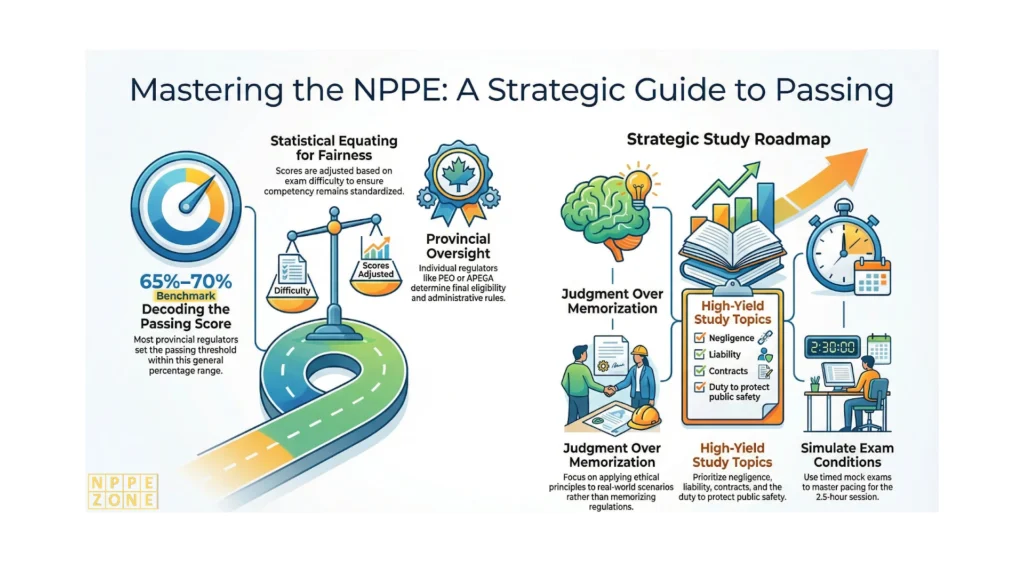
Provincial Oversight
Your provincial engineering regulator determines eligibility and passing requirements, not a national body:
- Ontario: PEO
- Alberta: APEGA
- British Columbia: EGBC
- Quebec: OIQ
Even though the exam content is standardized nationally, each regulator sets administrative rules, including how difficult it is to pass the NPPE exam in Canada.
Standardized Scoring and Equating
The NPPE is multiple-choice, computer-based, and timed. While you may see 110 questions, not all questions are weighted equally. Regulators use statistical equating to ensure fairness. Essentially, a 68% on one exam could represent the same competency as a 70% on a slightly harder session, reflecting the official NPPE exam scoring criteria Canada.
Typical Passing Thresholds
While each province may vary slightly, the general passing range is 65–70%, which aligns with the typical NPPE exam pass rate in Canada. The key takeaway? You don’t need a perfect score to pass. The exam tests practical professional judgment, not perfection in memorization.
What the Passing Score Means for Students
Passing the NPPE isn’t just about hitting a number. It’s about demonstrating that you:
- Understand ethics and professional responsibility
- Can apply engineering law in real-world scenarios
- Know your duty to protect the public
Many students mistakenly believe they must memorize every regulation. In reality, scenario-based questions reward professional judgment, which is exactly what the NPPE exam passing score Canada measures.Personal anecdote: I had a student who struggled with multiple-choice NPPE questions, thinking the “perfect” answer was always the longest one. Once we practiced scenario-based reasoning, tips to achieve the NPPE exam passing score in Canada became clear and achievable.
Tips to Achieve the NPPE Exam Passing Score in Canada
Focus on High-Yield Topics
Prioritize areas most frequently tested:
- Negligence and liability
- Conflict of interest
- Contracts and regulatory obligations
- Duty to report and public safety
- Professional ethics case studies
By focusing on these areas, you improve your chances of meeting the NPPE exam passing score Canada.
Practice Scenario-Based Questions
The NPPE is scenario-heavy. Multiple-choice questions often include two seemingly correct options. Practicing scenarios teaches you to select the answer that best aligns with public safety and professional standards. These NPPE exam preparation tips Canada help you focus on what really matters.
Tip: After each practice question, ask:
“Would this answer protect the public? Does it follow the code of ethics?”
Timed Mock Exams
Simulate exam conditions at least once or twice before test day. Time management is critical — 2.5 hours may feel long, but nuanced questions slow you down. Timed mocks teach pacing while maintaining thoughtful decision-making.
Track Your Progress
Log questions you get wrong and topics you struggle with. Reviewing patterns is one of the most effective ways to boost your NPPE passing grade requirements for engineers in Canada.
Common Mistakes That Affect Passing
- Over-reliance on memorization – NPPE is about application, not rote memory
- Ignoring provincial regulations – Review updates from your regulator
- Poor time management – Spending too long on one question can cost points
- Misinterpreting questions – Look for professional judgment, not just a technically correct answer
Personal anecdote: An EIT could recite the Engineers Canada Code of Ethics by heart but failed practice mocks until applying the rules to scenarios. Once adjusted, their NPPE exam score improved dramatically.
What to Do If You Don’t Pass
Failing the NPPE isn’t the end of the world. Most regulators allow multiple attempts, though limits or waiting periods may apply. Focus on:
- Reviewing weak areas
- Practicing scenario-based questions
- Simulating the exam again under timed conditions
Remember: the goal is to build professional judgment, not just check a box. Many engineers pass confidently on a second attempt — often with a higher score than the first try.
Extra Tips to Boost Your Passing Score
- Micro-study sessions: 15–20 minutes daily reviewing flashcards or scenarios reinforces concepts without overwhelming your schedule
- Group study: Discuss ethical dilemmas with peers to solidify reasoning
- Prioritize weak areas: Focus energy where it matters most to raise your overall NPPE exam passing score in Canada
- Simulate exam pressure: Timed practice improves focus and decision-making
- Track patterns against passing benchmarks: Avoid repeating mistakes
Following these strategies improves NPPE exam results and prepares you to act confidently as a professional engineer after licensure.
Maximizing Your Success with the NPPE Exam Passing Score Canada
Understanding your NPPE exam passing score in Canada isn’t just about hitting a number — it’s a tool to study smarter, reduce stress, and pass with confidence. By keeping the score in mind, you can:
- Plan your study efficiently to meet passing score targets
- Boost confidence before exam day
- Avoid burnout
- Improve professional judgment and exam readiness
- Increase your chances of passing on the first attempt
Think of the NPPE exam passing score Canada as a roadmap to prepare strategically, stay calm under pressure, and succeed both on the exam and in your engineering career.
How Understanding the NPPE Exam Passing Score Canada Helped Me Pass
When I first started preparing for the NPPE, I was overwhelmed by all the content and unsure how to focus my study time. Knowing the NPPE exam passing score in Canada gave me a clear benchmark. Instead of trying to memorize every regulation, I concentrated on understanding engineering ethics, law, and professional responsibility—the areas that matter most for passing.Tracking my progress against the NPPE exam scoring system for Canadian engineers allowed me to see where I was improving and where I needed extra review. I timed myself with practice exams and focused on scenario-based questions, which are a big part of the test. By keeping the NPPE passing grade requirements for engineers in Canada in mind, I could study efficiently, reduce stress, and feel confident walking into the exam.
The benefits were real:
- I studied smarter, not harder, and avoided burnout
- I knew exactly which topics to prioritize to hit the passing threshold
- I practiced judgment and reasoning rather than rote memorization
- When exam day came, I felt prepared and calm, not anxious
If you’re preparing for the NPPE, understanding the NPPE exam passing score in Canada isn’t just about a number—it’s about using that number to study strategically, make informed decisions, and walk into the exam confident that you can succeed on your first try.