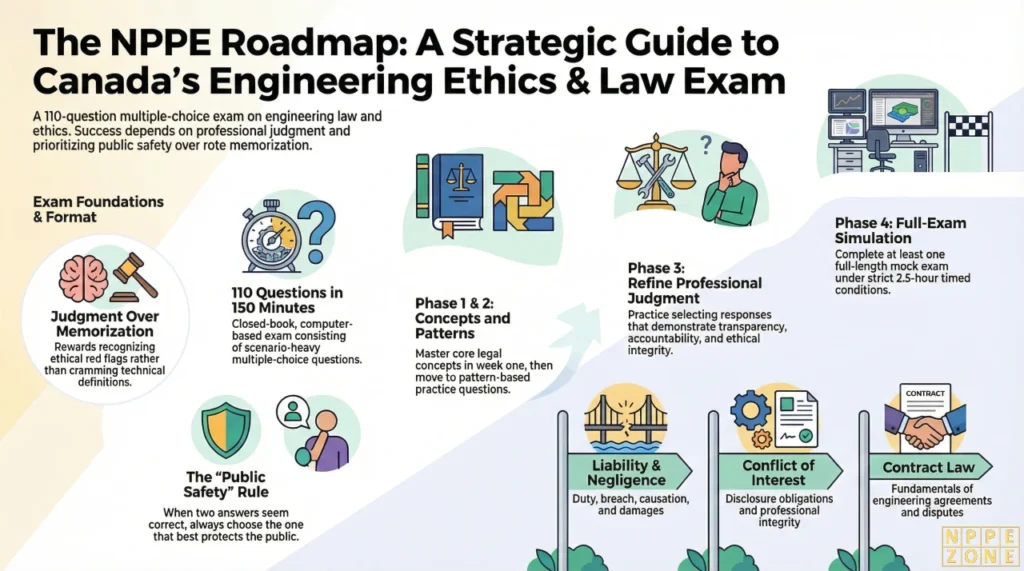
NPPE Exam Preparation Guide Canada
A Practical, Straight-Talking Roadmap from an Engineer Who’s Been There. If you’re searching for a complete NPPE Exam Preparation Guide Canada, you’re probably preparing to write the NPPE (National Professional Practice Examination) and wondering one of two things:
“It’s just ethics and law. How hard can it be?”
“This isn’t technical… So how do I even study for it?”
I’ve worked with engineers across disciplines — civil, mechanical, electrical, and software — and I can tell you this:
The NPPE isn’t difficult because it’s complex. It’s difficult because engineers underestimate it. This guide walks you through exactly how to prepare — efficiently, strategically, and with the right mindset — so you can pass the NPPE on your first attempt and move closer to earning your P.Eng. license in Canada. Whether you’re looking for a structured NPPE study guide, realistic NPPE preparation strategies, or clarity on how difficult the exam really is, this roadmap covers everything you need.
What the NPPE Actually Tests (And What It Doesn’t)
One of the biggest reasons engineers search for an NPPE exam preparation guide in Canada is uncertainty about what the exam actually evaluates. Let’s clarify something immediately. The NPPE is not trying to turn you into a lawyer. It is Canada’s mandatory engineering law and ethics exam, required by every provincial and territorial regulator as part of the professional engineering licensing process. The exam ensures that when you become a licensed engineer, you understand:
- Your ethical obligations
- Your legal responsibilities
- Your duty to protect the public
- How engineering practice operates within a Canadian regulatory framework
- How provincial engineering regulators enforce codes of ethics and professional standards
This is about professional accountability — not memorizing statutes.
It’s About Judgment, Not Memorization
When I wrote the NPPE, I made the classic engineer mistake: I created massive technical-style notes as if I were studying thermodynamics. That approach doesn’t work.
The NPPE rewards:
- Recognizing ethical red flags
- Applying legal principles to realistic scenarios
- Interpreting case-based multiple-choice questions
- Selecting the response that best protects the public
The strongest candidates approach the exam as practicing professionals, not students cramming definitions. That’s the foundation of any effective NPPE preparation strategy.
Understanding the Exam Format in This NPPE Exam Preparation Guide Canada
The NPPE is:
- Multiple choice
- Computer-based
- Closed book
- 2.5 hours long
- 110 questions
- Scenario-heavy
It focuses on engineering law and professional ethics in Canada.
You will see questions involving:
- Negligence
- Standard of care
- Conflict of interest
- Contract disputes
- Regulatory compliance
- Professional misconduct
- Tort law and liability
- Engineering Act obligations
- Professional discipline scenarios
The difficulty isn’t in the wording — it’s in the nuance. Often, two answers will look correct. Your task is to choose the most correct answer — the one that aligns with public safety, ethical integrity, and professional accountability.
Key NPPE Exam Details You Should Know
The NPPE is administered by provincial regulators such as PEO, APEGA, EGBC, and others across Canada.
Important facts:
- 110 multiple-choice questions
- 2.5-hour time limit
- Closed-book format
- Computer-based delivery
- Offered multiple times per year
Many candidates ask about the NPPE passing score and difficulty level. While the exact passing grade varies by regulator, most successful candidates aim for at least 70% to create a comfortable margin. The exam is conceptually nuanced rather than technically hard — which is why structured NPPE exam preparation is so important. Understanding these logistics helps you build a realistic NPPE study plan and avoid surprises on exam day.
How Long Should You Study for the NPPE?
This is one of the most common questions candidates ask.
For most engineers:
- 2–3 weeks is sufficient with focused daily study
- 4 weeks is ideal if you’re balancing work or family
- Longer timelines are rarely necessary unless you are retaking the exam
The key isn’t duration. It’s structure. A well-designed NPPE study schedule should combine concept review, practice exams, and timed simulations.
The 4-Phase Study Strategy
After mentoring candidates — including retakers — I’ve refined a simple system that works consistently.
Phase 1: Understand the Core Concepts (Week 1)
Before touching practice exams, make sure you truly understand:
- Negligence (duty, breach, causation, damages)
- Standard of care
- Vicarious liability
- Conflict of interest
- Professional misconduct
- Contract law fundamentals
- Duty to report
- Engineering code of ethics principles
- Professional liability and risk management
- Occupational health and safety obligations
Don’t memorize definitions — understand how they appear in real scenarios.
Phase 2: Move Quickly to Practice Questions (Week 2)
This is where most improvement happens.
NPPE questions are pattern-based. Once you’ve done enough high-quality NPPE practice exams, you’ll start recognizing themes:
- “This is a disguised conflict of interest.”
- “This scenario is testing the standard of care.”
- “They’re examining disclosure obligations.”
- “This is a regulatory compliance issue under provincial legislation.”
Do at least 2–3 full mock exams before your actual test date. If you’re considering an NPPE prep course or online NPPE preparation program, prioritize those that emphasize realistic scenario-based practice questions over passive video lectures. Application is what builds exam readiness.
Phase 3: Refine Professional Judgment (Week 3)
At this stage, you know the content. Now you refine decision-making.
If two answers seem correct, choose the one that most clearly:
- Protects public safety
- Aligns with ethical accountability
- Demonstrates transparency
- Upholds professional integrity
The NPPE consistently rewards public-interest prioritization.
Phase 4: Simulate Real Conditions (Final Week)
Do at least one full-length exam under strict timing. No notes. No pausing. No distractions. Replicate the 2.5-hour exam environment exactly. Simulation builds stamina and reduces anxiety.
High-Yield Topics You Must Know Cold
If I had to narrow down the most frequently tested areas, they would be:
- Negligence & liability
- Conflict of interest
- Contracts
- Duty to report & public safety
- Engineering ethics case studies
- Professional discipline and regulatory investigations
These areas consistently appear in NPPE practice exams and reflect recurring engineering law exam patterns across Canada.
To be fully prepared, you should also understand:
- Canadian tort law principles
- Limitation periods
- Insurance and professional liability coverage
- Intellectual property (copyright and patents)
- Environmental regulations
- Professional engineer (P.Eng.) responsibilities
- Whistleblowing and disclosure obligations
- Continuing professional development (CPD) requirements
- Provincial Engineering Act frameworks
These are not obscure topics — they regularly appear in scenario-based exam questions.
Common Mistakes in NPPE Preparation
- Treating it like a technical exam
- Memorizing instead of understanding
- Underestimating timing
- Avoiding full-length practice exams
- Overthinking simple scenarios
- Failing to align answers with the duty to protect the public
Avoid these, and your probability of passing increases dramatically.
NPPE Exam Preparation Guide Canada – Frequently Asked Questions
Is the NPPE difficult?
The NPPE is manageable with proper preparation. It tests applied judgment and ethics rather than technical engineering knowledge.
Is the NPPE an open book?
No. It is a closed-book, computer-based exam.
l provinces require the NPPE?
Yes. Every Canadian engineering regulator requires the National Professional Practice Examination for P.Eng. licensure.
What is the best way to prepare for the NPPE?
Understand core legal principles, complete multiple full-length NPPE practice exams, and simulate real test conditions.
Why This NPPE Exam Preparation Guide Canada Approach Works
If you’ve been searching for a reliable NPPE study guide in Canada, you’ve likely seen everything from dense textbooks to generic exam tips. The difference here is structure.
A strong NPPE preparation guide should:
- Clarify what actually matters
- Teach you how to apply legal principles
- Build professional judgment
- Prepare you specifically for the Canadian engineering licensing process
That’s exactly what this roadmap does.
Who This Guide Is For
This NPPE exam preparation guide Canada is designed for:
- Engineers-in-Training (EITs)
- Internationally trained engineers
- First-time NPPE writers
- Repeat test-takers
- Applicants completing P.Eng. licensing requirements
Whether you’re applying through PEO, APEGA, EGBC, or another provincial regulator, the preparation principles remain the same.
Final Thoughts
The NPPE isn’t testing whether you’re smart. It’s testing whether you’re ready to be trusted. If you follow a structured NPPE exam preparation strategy, understand the core concepts, practice consistently, simulate real conditions, and refine your judgment, you won’t just be ready to pass. You’ll be ready to practice as a responsible professional engineer in Canada. And that’s what the exam is really about.