NPPE for P.Eng Licensing Canada: How It Fits Into the Process and How to Pass
Quick Answer
The NPPE requirements for P.Eng licensing in Canada include passing the National Professional Practice Examination as a key step in becoming a licensed Professional Engineer. The exam evaluates your understanding of ethics, law, and professional practice, and it must be completed alongside education and work experience requirements to obtain your P.Eng designation.
Introduction
If you’re working toward your P.Eng in Canada, you’ve probably come across the NPPE and wondered where it fits into the bigger picture.
When I first looked into the licensing process, I assumed the NPPE was just another exam to check off. Over time, it became clear that it plays a much larger role—it’s where technical knowledge connects with real-world responsibility and decision-making.
This guide explains how NPPE fits into P.Eng licensing process Canada, outlines the full pathway, and provides a clear understanding of how to approach it effectively. Understanding NPPE for P.Eng licensing Canada early can make the entire process more efficient and less stressful.
Canadian Engineering Licensure Process NPPE Explained
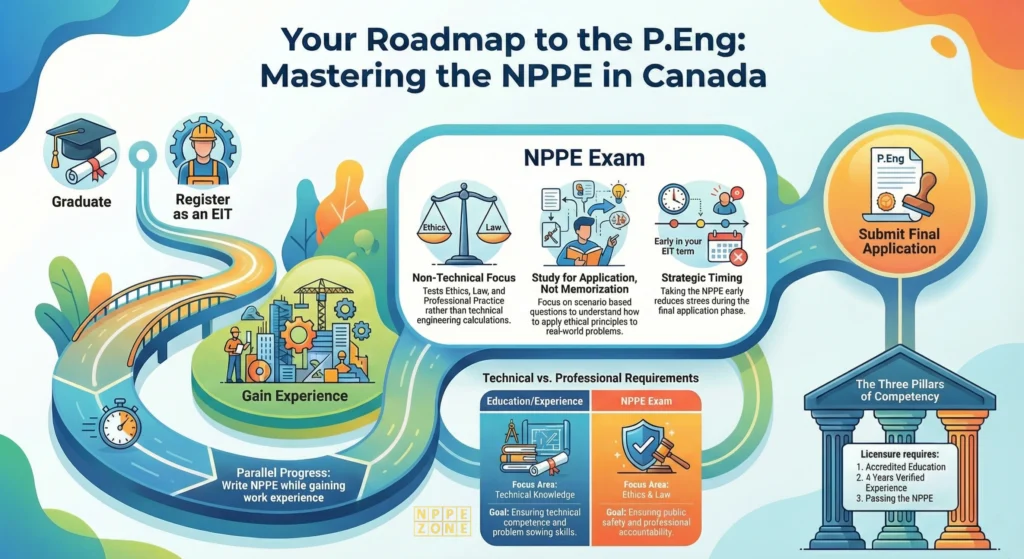
The Canadian engineering licensure process NPPE explained is built on three core components:
- Education – Accredited engineering degree or equivalent
- Work Experience – Typically four years of relevant experience
- Professional Practice Exam (NPPE) – Ethics, law, and professional responsibility
These elements work together to ensure engineers are both technically competent and professionally accountable.
The NPPE plays a key role by bridging theory and practice, reinforcing your responsibilities as an engineer in Canada.
How NPPE Fits Into P.Eng Licensing Process Canada
Understanding how NPPE fits into the P.Eng licensing process Canada helps you plan your path more strategically.
The NPPE is typically completed:
- After registering as an Engineer-in-Training (EIT)
- While gaining required work experience
- Before final approval for your P.Eng designation
Many candidates don’t realize they can take the exam before finishing their experience. Writing it earlier often reduces pressure later and allows you to focus fully on experience requirements.
Steps to Get P.Eng in Canada NPPE Exam Explained
A simplified breakdown of the steps to get P.Eng in Canada NPPE exam explained:
Step 1: Meet educational requirements
Graduate from an accredited engineering program or equivalent
Step 2: Apply as an Engineer-in-Training (EIT)
Register with your provincial regulator
Step 3: Gain work experience
Complete supervised engineering experience
Step 4: Write and pass the NPPE
Fulfill the professional practice requirement
Step 5: Submit final application
Apply for your P.Eng once all requirements are complete
Each step builds toward demonstrating readiness for professional responsibility.
NPPE Requirements for P.Eng Licensing in Canada
The NPPE requirements for P.Eng licensing in Canada are generally consistent across provinces.
To qualify, you must:
- Be registered with a provincial engineering body
- Receive approval to write the exam
- Successfully pass the NPPE
The exam focuses on ethics, law, and professional practice.
NPPE Exam Importance for P.Eng Designation Canada
The NPPE exam importance for P.Eng designation Canada lies in its focus on real-world responsibility.
It helps ensure that engineers:
- Understand legal obligations
- Apply ethical decision-making
- Navigate professional scenarios effectively
- Prioritize public safety
NPPE Exam Role in Becoming a Professional Engineer Canada
The NPPE exam role in becoming a Professional Engineer Canada is to validate your understanding of non-technical responsibilities.
Engineering involves more than solving technical problems. It requires:
- Sound judgment
- Clear communication of risks
- Ethical decision-making under pressure
NPPE and Work Experience Requirements for P.Eng Canada
Understanding NPPE and work experience requirements for P.Eng Canada helps you manage your timeline effectively.
Key points:
- NPPE and work experience can be completed in parallel
- Experience must demonstrate applied engineering competence
- Professional judgment and responsibility are essential
Timeline for P.Eng Licensing with NPPE Exam Canada
The timeline for P.Eng licensing with NPPE exam Canada typically follows this structure:
- Year 0: Graduate and register as EIT
- Years 1–4: Gain work experience
- During this period: Write and pass NPPE
- After completion: Apply for P.Eng
P.Eng Licensing Requirements Including NPPE Canada
The full P.Eng licensing requirements including NPPE Canada include:
- Accredited education
- Verified work experience
- Passing the NPPE
- Professional references
- Approval from the regulator
How to Pass NPPE for Engineering Licensure in Canada
If you’re wondering how to pass NPPE for engineering licensure in Canada, focus on practical application.
Effective strategies include:
- Prioritize understanding over memorization
- Practice scenario-based questions consistently
- Focus on ethics, law, and professional practice
- Simulate timed exam conditions
- Review mistakes carefully
What the Exam Is Testing
The NPPE evaluates your ability to:
- Apply ethical principles
- Understand legal responsibilities
- Make sound professional judgments
- Analyze real-world scenarios
This reflects core NPPE Canadian law, ethics, and professional responsibility concepts required for licensing.
Understanding Regulatory Bodies in the P.Eng Licensing Process
To fully understand NPPE for P.Eng licensing Canada, it’s important to recognize the role of provincial regulators.
Organizations such as Engineers and Geoscientists British Columbia (EGBC) and Professional Engineers Ontario (PEO) oversee licensing, enforce standards, and verify that candidates meet all requirements.
They are responsible for confirming P.Eng licensing requirements including NPPE Canada, as well as defining how the NPPE exam role in becoming a Professional Engineer Canada is applied within each province.
Maximizing Your P.Eng Path with the NPPE
Understanding the Canadian engineering licensure process NPPE explained, allows you to approach your licensing journey more strategically.
Knowing how NPPE fits into the P.Eng licensing process Canada helps you align exam timing with your work experience and reduce stress.
A clear understanding of NPPE and work experience requirements for P.Eng Canada also helps connect exam preparation with real-world experience.
By planning around the timeline for P.Eng licensing with NPPE exam Canada, you can set realistic milestones and stay on track.
Ultimately, understanding the NPPE exam role in becoming a Professional Engineer Canada builds confidence for both the exam and your future responsibilities.
Final Thoughts
Understanding the NPPE requirements for P.Eng licensing in Canada is a key step in becoming a licensed engineer.The NPPE represents the transition from technical knowledge to professional responsibility. By learning how NPPE fits into the P.Eng licensing process Canada and preparing effectively, you can move forward with clarity and confidence.