NPPE Law Questions Explained: How to Understand, Analyze, and Answer with Confidence
Quick Answer
NPPE law questions for Canadian engineers explained focus on your ability to apply legal principles—such as contracts, negligence, and liability—to real-world engineering scenarios. The best way to prepare is by practicing sample NPPE law exam questions and answers, understanding how to break down scenarios step by step, and learning how legal concepts apply in professional situations rather than memorizing definitions.Understanding NPPE law questions explained in the context of real-world engineering scenarios helps candidates prepare for the exam format, improve legal reasoning, and confidently approach NPPE law questions for Canadian engineers explained across contracts, negligence, and professional responsibility topics.
Why NPPE Law Questions Matter for Engineers
When preparing for the NPPE, many candidates spend most of their time on ethics and underestimate the law component. That’s a mistake.
From experience helping people prepare for similar professional exams, law questions often become the deciding factor between passing and struggling—because they test how well you can apply abstract legal principles to practical situations.
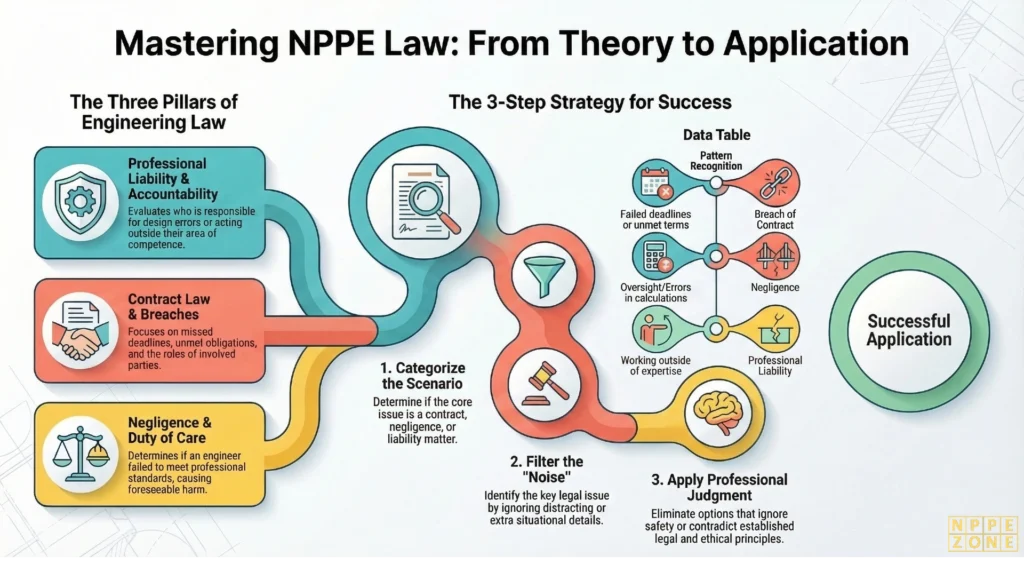
Canadian engineering law questions NPPE explained typically assess:
- Your understanding of professional liability
- Your awareness of contractual obligations
- Your ability to recognize negligence and duty of care
- Your judgment in legal and professional scenarios
These aren’t questions you can memorize your way through—you have to understand the reasoning behind them.
What NPPE Law Questions Actually Look Like
Most NPPE exam law practice questions with explanations are scenario-based. You’ll be given a situation and asked what the engineer should do or what legal principle applies. These questions often include:
- A workplace conflict or contract issue
- A design error or liability concern
- A dispute between parties
- A breach of professional responsibility
Instead of asking direct definitions, the exam tests how you apply legal concepts in context.
How NPPE Law Questions Are Structured in the Exam
NPPE law questions explained are typically presented as multiple-choice, scenario-based questions designed to test applied understanding rather than memorization. A typical question structure includes:
- A short engineering scenario involving a legal issue
- A question asking what the engineer should do or what principle applies
- Four answer choices with one best answer
These NPPE law questions for Canadian engineers explained often require candidates to evaluate:
- Legal responsibility and liability
- Contractual obligations and breaches
- Professional standards and duty of care
- Appropriate decision-making under pressure
Practicing NPPE legal scenario questions and explanations helps candidates become familiar with how these questions are framed and how to identify the most correct response efficiently.
Key Legal Topics Tested in NPPE Law Questions
Professional Liability
Understanding who is responsible when something goes wrong is a major part of professional liability and contract law NPPE questions.
These concepts are frequently tested in NPPE law questions breakdown for engineers in Canada because they assess how responsibility is assigned in real engineering situations. You may be asked:
- Who is liable for a design error?
- What happens if an engineer acts outside their competence?
Contract Law
Contracts are central to engineering work. NPPE questions may test:
- Terms and conditions
- Breach of contract
- Roles and responsibilities of parties
This is a core component of NPPE exam law practice questions with explanations, as contract disputes are common in engineering projects.
Negligence and Duty of Care
This is one of the most commonly tested areas.
Understanding negligence is essential for answering common NPPE law questions and solutions that involve errors, oversight, or failure to meet professional standards.
Regulatory and Professional Obligations
These questions connect legal expectations with engineering practice:
- Compliance with licensing bodies
- Adherence to codes of conduct
- Legal vs ethical responsibilities
Sample NPPE Law Exam Questions and Answers
Let’s walk through a few simplified examples to illustrate how these concepts appear in practice.
These reflect the types of common NPPE law questions and solutions you’ll encounter on the exam.
How to Answer NPPE Law Questions Step by Step
Learning how to answer NPPE law questions step by step is one of the most valuable skills you can develop.This structured approach is especially effective when working through NPPE exam law practice questions with explanations, as it mirrors how NPPE law questions explained are designed to test reasoning rather than memorization.
Understanding NPPE Law Questions for Exam Preparation
Developing a deep understanding of NPPE law questions for Canadian engineers, helps you move beyond memorization and into practical reasoning.
When you practice regularly, you start recognizing patterns—especially when reviewing NPPE legal scenario questions and explanations.
Common NPPE Law Questions and Solutions Patterns
As you work through practice materials, you’ll notice recurring patterns in common NPPE law questions and solutions:
- Contract breaches
- Negligence scenarios
- Liability issues
- Competence violations
NPPE Law Questions Breakdown for Engineers in Canada
A deeper NPPE law questions breakdown for engineers in Canada shows that these questions are less about memorizing statutes and more about applying reasoning.
Understanding this helps you prepare more effectively using NPPE exam law practice questions with explanations.
Personal Insight: Why Practice Matters More Than Reading
Working through sample NPPE law exam questions and answers repeatedly trains your brain to:
- Analyze scenarios
- Identify legal issues
- Apply concepts under pressure
Tips for Studying NPPE Law Questions Effectively
Using NPPE exam law practice questions with explanations consistently will significantly improve your confidence and accuracy.
Why NPPE Law Questions Explained Improves Exam Performance
Mastering NPPE law questions explained gives candidates a significant advantage because it strengthens both conceptual understanding and practical application.
By consistently practicing NPPE law questions for Canadian engineers explained, you become more familiar with how legal principles appear in scenario-based formats.
Using sample NPPE law exam questions and answers alongside NPPE legal scenario questions and explanations reinforces key topics such as professional liability and contract law NPPE questions.
As you work through common NPPE law questions and solutions, you begin to recognize repeated themes such as duty of care, negligence, and contractual breaches.Ultimately, combining NPPE exam law practice questions with explanations with a structured study approach ensures strong preparation.
FAQ: NPPE Law Questions Explained
What types of law questions are on the NPPE?
They typically include scenarios involving contracts, negligence, liability, and professional responsibility.
Are NPPE law questions difficult?
They can be challenging because they test application rather than memorization.
How should I study NPPE law questions?
Use practice questions and focus on understanding legal principles in context.
Final Thoughts
NPPE law questions for Canadian engineers explained are designed to test how well you can apply legal principles in real-world engineering situations.
By studying sample NPPE law exam questions and answers, practicing NPPE legal scenario questions and explanations, and learning how to answer NPPE law questions step by step, you build both confidence and competence.
With consistent practice and a clear understanding of core legal concepts, NPPE law questions become much more predictable—and much easier to navigate on exam day.